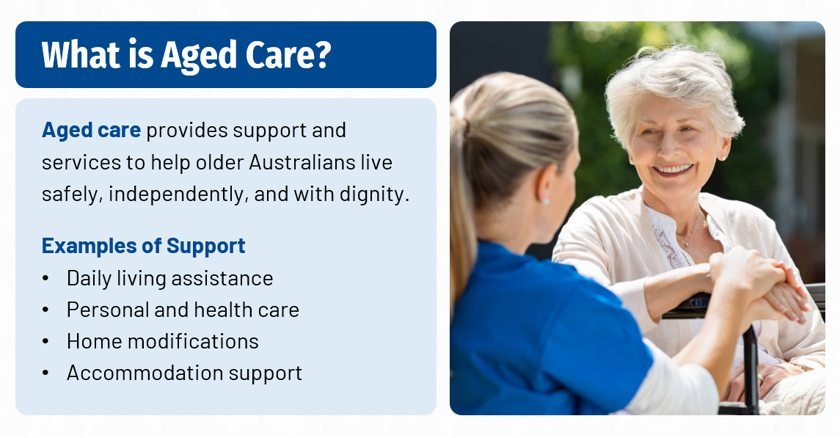
Turning dense and initially ambiguous subject-matter content into a focused foundation learning experience for potential Australian aged-care support operations.
19 pages of dense SME content, a broad learner profile, and two to three weeks to turn it into a foundation course.
What I did
Curated with Must Know vs. Nice to Know, rescoped from 8 hours to 4, and built six modules with scenarios and multimedia.
The result
A 4-hour training deck approved by the project manager, SMEs, and manager, now used to showcase training offerings.
01
The Situation
A project manager was preparing training for a potential Australian client whose business involved aged care. A project briefing was held with the team members involved, who also served as subject-matter experts.
The team provided approximately 19 pages of source material covering Australian aged care, the Aged Care Act, and the My Aged Care platform, with no executive summary or detailed instructional brief.
The learner description was initially broad: Philippine support staff who might be assigned to an Australian aged-care client. My initial review showed the material would need significant structure and curation before it could become a digestible learning experience.
The starting point. Around 19 pages of SME source material, with no executive summary or instructional brief.
02
The Problem
The instructional problem
How do you transform dense, broad information into a focused foundation course without overwhelming learners with content that is too detailed, too specialized, or not relevant to their role?
The broad learner description also raised a question: should clinical or direct-care content be included? As the scope became clearer, the focus stayed on foundational knowledge of the Australian aged-care environment rather than job-specific or clinical training.
03
The Audience
Target learners: Philippine support staff who may be assigned to an Australian client operating in the aged-care sector.
What learners needed
Understand the Australian aged-care system and key services.
Understand the Aged Care Act, older people's rights, and quality care.
Understand My Aged Care.
Apply person-centred care and appropriate communication.
Recognize quality and safeguarding considerations.
Constraints: foundation-level scope, no unnecessary job-specific detail, instructor-led delivery, and a development timeline of about two to three weeks.
04
My Role
I led the design from source analysis through to the approved deck, working with SMEs at the project briefing and final review.
Separating essential from supplementary information
Clarifying learner and course scope
Drafting and refining learning objectives
Structuring the course and content coverage
Designing knowledge checks and scenarios
Selecting appropriate multimedia
Integrating person-centred care throughout
Moving supplementary content into trainer notes
Developing the instructor-led training deck
Collaborating with SMEs on design and review
Incorporating stakeholder feedback
05
My Approach
01
Analyze the 19-page source material rather than transferring it directly into slides.
02
Clarify course scope around Australian aged care, the Aged Care Act, and My Aged Care.
03
Apply a Must Know vs. Nice to Know filter.
04
Move useful-but-supplementary information into trainer notes, or exclude it when it didn’t support the course.
05
Use learning objectives as a second content filter.
06
Agree a 4-hour foundation course (instead of 8) with the manager and training team.
07
Refine non-observable objectives and structure the experience into six modules.
08
Add knowledge checks, scenarios, and multimedia; submit for SME and manager review.
Course structure
MODULE I
Understanding the Australian Aged Care System
MODULE II
Key Aged Care Services
MODULE III
The Aged Care Act, Client Rights, and Quality Care
MODULE IV
Accessing Services Through My Aged Care
MODULE V
Person-Centred Care and Communication
MODULE VI
Quality, Safeguarding, and Sector Challenges
06
Design Decisions
Must Know vs. Nice to Know
What I chose: Keep essential information learner-facing; move supplementary content to trainer notes or exclude it.
Why: The goal was a digestible foundation course, not a comprehensive reference guide.
Objectives as a content filter
What I chose: Check whether each content element supports an intended learning outcome.
Why: It kept the course from becoming a collection of interesting but unnecessary information.
From 8 hours to 4
What I chose: Establish a 4-hour foundation course with the manager and training team.
Why: Existing onboarding foundation courses used a 4-hour format; job-specific content could be addressed separately.
Person-centred care as a thread
What I chose: Reinforce person-centred care throughout rather than as an isolated topic.
Why: The new aged-care approach emphasizes the rights of older people, and the concept was already in the source.
Observable objectives
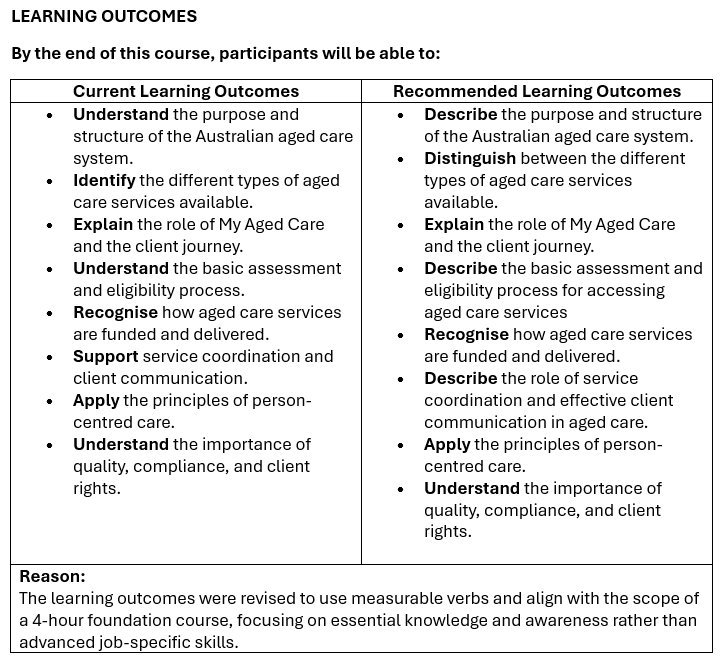
What I chose: Revise verbs like “Understand the purpose…” to “Describe the purpose…”.
Why: Observable objectives give a clearer basis for assessment and alignment.
Scenarios for safeguarding
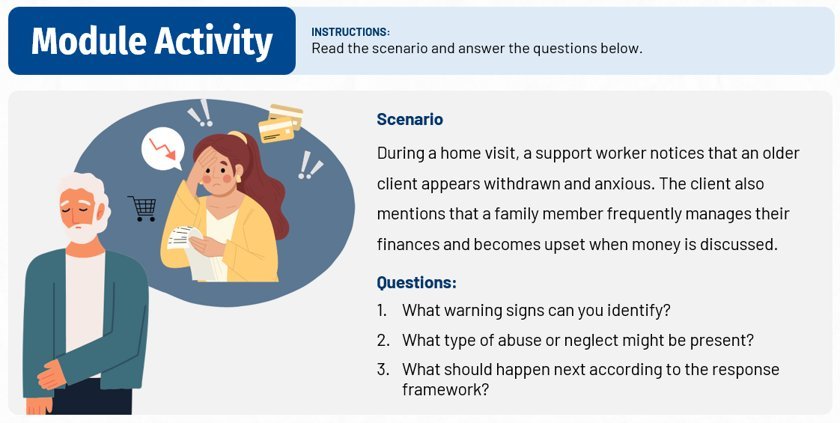
What I chose: A scenario where learners spot abuse or neglect warning signs and decide what happens next.
Why: Safeguarding requires recognition and response, not only recall.
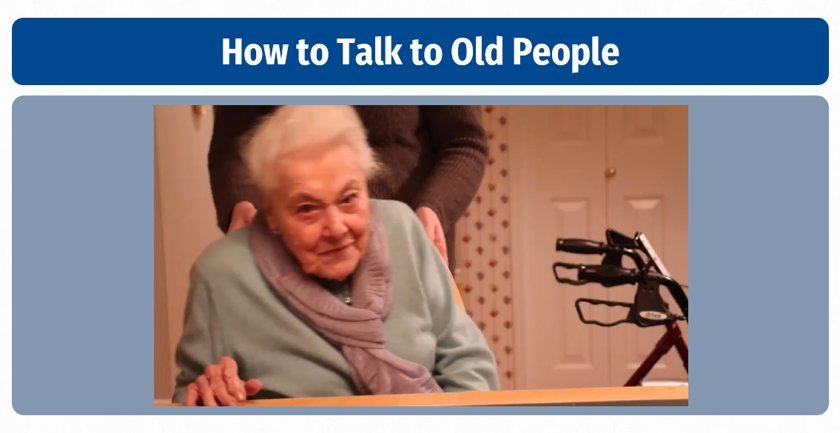
Multimedia with purpose: an external video of an older woman sharing questions to ask older people, plus Australian government videos on the Aged Care Act and My Aged Care. Together, these reinforced that older people shouldn’t automatically be treated as weak or incapable.
Decisions in practice
Observable objectives. Current versus recommended learning outcomes, revised to use measurable verbs and fit a 4-hour foundation course.
Scenario for safeguarding. Learners identify warning signs of abuse or neglect and decide what should happen next.
Multimedia for learner perspective. A video in which an older woman gives guidance on the questions to ask older people.
07
Outcome
The dense source material became an approved 4-hour foundation training deck structured around six modules, with curated content, refined objectives, knowledge checks, scenario-based learning, multimedia, person-centred care concepts, and trainer notes.
The deck was reviewed and approved by the project manager, SMEs, and manager, and the project team responded positively. It is currently used to showcase possible training offerings to potential clients.
The course has not yet been delivered to learners, so no learner-satisfaction, learning-gain, or performance claims are made here.
08
Reflection
What worked
Content curation kept the course from becoming an information dump. The Must Know vs. Nice to Know filter and objective alignment made the 19-page source manageable.
What was challenging
The early ambiguity in the learner profile, including whether clinical content belonged. The short timeline also limited SME input to the briefing and final review.
What I learned
Content analysis isn’t only about what’s accurate or relevant. It’s about what the learner actually needs at that point in their learning journey.
What I'd change
Clarify the learner profile and job scope earlier.
Build in a structured SME review during development.
After delivery, check the 4-hour duration and scope.